 Article Features
1. The National PTA "Parental Involvement in Schools" PSA link
2."10 Things You can do to Prevent Violence in Your School Community" PTA link
3."Safe and Secure Schools, The Parent Factor" PTA link
4. SAMHSA's National Mental Health Center "Safe Schools,Healthy Students" link
5. The National Education Foundation "Crisis Communication Guide and Toolkit" link
Playground of Violence
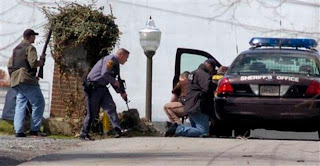
While those on the campus of Virginia Tech University were dealing with tragic violence, a Southern California Elementary/Junior High school was evacuated after a note was found stating that there was a bomb on campus. It seems that our schools, elementary, high school and colleges are becoming a battleground of violence. Most often it’s the extreme violence that is reported nationwide, however, lurking in its shadow are other forms of aggressive/violent behavior that students are subjected to on a daily basis. Sometimes the "minor" acts of aggression, such as bullying, develop into destructive violence,violence that destroys lives and a sense of security.

Managing School Safety
Emergency Management is most often referred to in the context of a natural disaster, but emergency management principles can also be applied to a man-made disaster such as this.As with natural disasters, private citizens and businesses are expected to do whatever they can to prepare, respond and recover from an incident. Local, State, Tribal and Federal Agencies have a limited capacity. Although campus, local and state police do their best to provide a safe and secure campus, it is the responsibility of students, parents, faculty and everyone who does business with academia to apply emergency management principles in their routine to contribute towards a safer environment.

School Safety Management
The four phases of successful emergency management are:- Mitigation-any actvity that reduces or prevents an emergency from happening.
- Preparedness-plans or preparations made to save a life and help response and rescue efforts.
- Response-putting preparedness plans into action, actions taken to save lives and prevent further damage.
- Recovery-actions taken to return to a normal or an even safer situation following an emergency.
Mitigation
 Parental involvement with a child's education and more.
The PTA released a set of Public Service Announcements(PSA's) the PSA's end with the line, “Know What Really Matters. Know about your kid’s school, and Know about your kid.” Please review the PTA's "10 Things You can do to Prevent Violence in Your School Community" and "Safe and Secure Schools, the Parent Factor" Keeping the lines of communication open and being actively involved in your child's education will help to mitigate the possible hazards.
Home-Schooling has become an option for many and continues to grow in popularity. According to United States Department of Education report NCES 2003-42,"Homeschooling in the United States: 2003",there was an increase in homeschooled students in the U.S. from 850,000 students in 1999 to 1.1 million students in 2003. The same report said that 85 percent of homeschooling parents cited "the social environments of other forms of schooling" (including safety, drugs, bullying and negative peer-pressure) as an important reason why they homeschool.
On-line or Hybrid Classes offer a student the flexibility of taking classes or obtaining a degree with a minimal amount of time spent on campus, in some cases the course is taught strictly on-line.
Preparedness
How do you prepare for violent situations in the classroom or on the campus? In this respect one must prepare the senses.
- Be alert to what is happening, know your environment.
- Many times students or others will talk about what they might be planning to do, do not dismiss it! Tell someone of authority.
- Cell phones, used properly, have become a lifeline, a means of communicating to those on the outside. Information that can be given to the authorities will help them and you.
- Continue to warn children about strangers and practice with them what they should avoid and what they should do if they are approached or grabbed a hold of.
- If you forget their name remember their face. Not all violence committed on campus is perpetrated by a student. Campuses are open centers of learning in many areas, therefore the general public has access. Get the best description you can without endangering your life, remember everything, what you saw, heard and smelled, before, during and after the incident. Seemingly small things may be a big lead in the investigation
Response
Stay out of the way, stay low, stay hidden if necessary! This applies to any form of violence that may be happening at the time. Most primary and secondary schools have campus police trained to deal with these very situations. Provide the help if you can, but first, you must be able to save yourself if you want to safely save others.
Officials are having students and faculty practice "Shelter in Place" , if the violence is occuring outside of the classroom stay inside! until the police have secured the area and release you.
Recovery
Be an instrument of recovery for the survivors, all the while making sure that you yourself are not becoming overwhelmed by your own emotions and experiences. Remember, rescuers can become victims also.
When the tornado is gone nothing but destruction remains. The survivors are left to pick up the physical and...emotional pieces. This is the most difficult time. All of those in the lives of the survivors will have a responsibility to help them pick up and heal the emotional and sometimes physical scars of the incident. In this regard there are many resources to draw from.
SAMHSA'S National Mental Health Center "Safe Schools,Healthy Students" program offers various types of material helping those who have been involved in a traumatic event.

Also The National Education Association offers a Crisis Communication Guide and Toolkit as well as other excellent resources to turn to in a time of destruction, mourning, grieving and rebuilding.